
Keywords: Continuous Glucose Monitoring, Obstructive Sleep Apnea, Glycemic Variability, Intermittent Hypoxia, Nocturnal Glycemia, Cardiometabolic Risk
Introduction
For most of clinical history, our picture of a patient’s glucose metabolism has been assembled from snapshots: a fasting venous sample drawn in the morning, an oral glucose tolerance test conducted under artificial conditions, or an HbA1c that averages roughly three months of glycemia into a single number. These tools have served epidemiology and diagnosis well, but they share a structural blind spot. They tell us very little about what the body is doing while the patient sleeps, the eight or so hours each night when, in a substantial fraction of metabolically at-risk adults, breathing repeatedly falters, oxygen saturation dips, and the autonomic nervous system is jolted awake hundreds of times. It is in this nocturnal window that obstructive sleep apnea does much of its metabolic damage, and it is precisely this window that traditional monitoring leaves dark [1,12].
Obstructive sleep apnea is common and substantially underdiagnosed. Symptomatic OSA affects an estimated two to four percent of the general adult population, but its prevalence rises steeply in metabolically compromised groups: polysomnographically confirmed OSA has been reported in roughly 18 percent of primary-care patients with prediabetes or type 2 diabetes, climbing to 58 percent in older cohorts and as high as 86 percent in obese patients with type 2 diabetes. Conversely, between 15 and 30 percent of patients carrying an OSA diagnosis also meet criteria for type 2 diabetes. These figures describe not two separate epidemics but a single intertwined one, in which adiposity, insulin resistance, and upper-airway collapse reinforce one another [2,3].
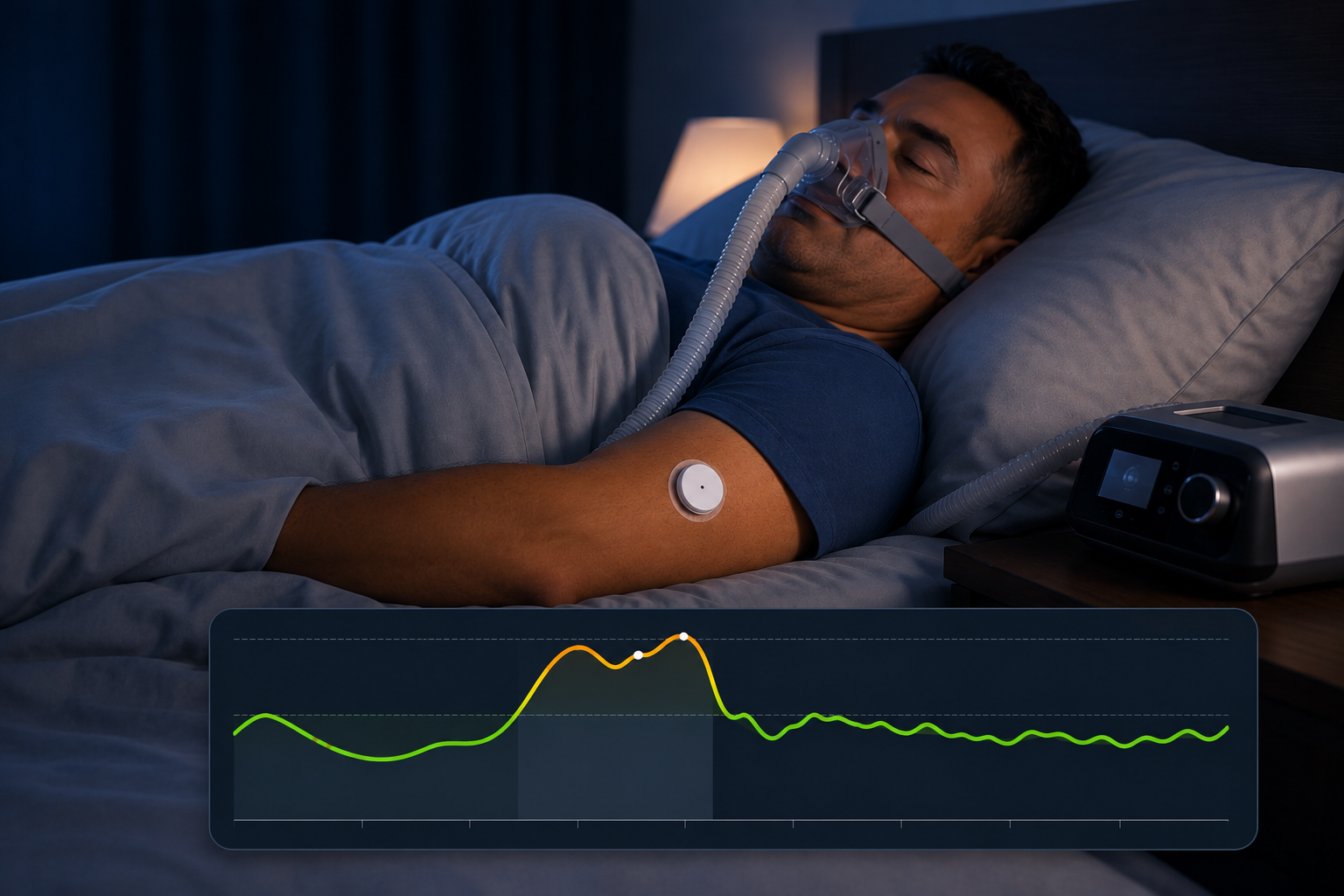
Continuous glucose monitoring has matured over the same period into a technology capable of illuminating the night. A modern CGM sensor measures interstitial glucose every one to five minutes for up to two weeks, generating thousands of data points and a continuous trace rather than isolated values. For a clinic oriented toward longevity, prevention, and the early interruption of metabolic disease, this temporal density is transformative. It allows clinicians to see the glycemic signature of a disordered night, the sawtooth excursions, the paradoxical post-sleep-onset rise, the blunted nocturnal dip and to use that signature both as a diagnostic clue and as a target for intervention [12,17].
This review examines the intersection of these two domains. It begins with the epidemiology and pathophysiology that make OSA a metabolic disease as much as a respiratory one, then turns to the specific CGM-derived metrics that capture apnea-driven glycemic stress and the studies that have deployed them. It evaluates the evidence on CPAP as a metabolic intervention, considers the practical and emerging role of CGM combined with sleep-tracking wearables in preventive practice, and closes by outlining the limitations of the current evidence base and a research and clinical agenda for a longevity-focused setting.
The Bidirectional Relationship Between OSA and Glucose Dysregulation
The association between sleep-disordered breathing and impaired glucose handling is one of the more robust findings in cardiometabolic medicine, and it runs in both directions. Cross-sectional and longitudinal data consistently show that OSA is associated with insulin resistance, glucose intolerance, and incident type 2 diabetes independent of age and body mass index. The PROOF cohort, which followed an initially healthy elderly population for seven years, found that even asymptomatic OSA was associated with the later development of insulin resistance and type 2 diabetes, strengthening the case that apnea is not merely a marker of obesity but an independent contributor to metabolic decline [3,5,7].
The strength of the relationship scales with apnea severity. As the apnea-hypopnea index (AHI) rises, so do measures of insulin resistance and dysglycemia, and indices of nocturnal hypoxic burden, the proportion of sleep time spent below an oxygen-saturation threshold, and the depth of desaturation track insulin resistance even in prediabetic patients with severe disease. This dose-response pattern is one of the clearest signals that the link is mechanistic rather than incidental. The reciprocal direction is equally well documented: diabetes itself, through mechanisms that may include autonomic neuropathy affecting upper-airway control and ventilatory drive, appears to increase the risk and severity of sleep-disordered breathing, creating a self-reinforcing loop [2,4,8].
For a preventive clinic, the practical implication is that a patient presenting with either condition warrants screening for the other. A patient with newly diagnosed type 2 diabetes and an elevated body mass index has, on the evidence above, a high pre-test probability of coexisting OSA; a patient referred for loud snoring and witnessed apneas carries meaningful odds of occult dysglycemia. Treating one disorder while ignoring the other leaves a substantial driver of cardiometabolic risk in place [3,4].
Mechanisms: How Disordered Breathing Disturbs Glucose
The pathways connecting OSA to glycemic dysregulation are multiple and overlapping, but they converge on two cardinal features of the disorder: chronic intermittent hypoxia and recurrent arousal-driven sleep fragmentation. Each repetitive apneic event produces a transient fall in arterial oxygen followed by reoxygenation upon arousal, a cycle that, repeated hundreds of times per night, resembles an ischemia-reperfusion stress applied to the whole organism [3].
Intermittent Hypoxia, Sympathetic Activation, and Counter-Regulation
Intermittent hypoxia is a potent activator of the sympathetic nervous system. The repeated surges in sympathetic outflow stimulate hepatic gluconeogenesis and glycogenolysis, promote lipolysis with consequent elevation of circulating free fatty acids, and impair insulin-mediated glucose uptake in skeletal muscle. Experimental work isolating this mechanism is particularly persuasive: when healthy volunteers were exposed to acute intermittent hypoxia while awake, insulin sensitivity fell and sympathetic activity rose, demonstrating that the hypoxic stimulus alone like absent obesity, absent sleep loss is sufficient to perturb glucose metabolism. Counter-regulatory hormones including cortisol and catecholamines, secreted in response to the recurrent arousals, compound the effect by antagonizing insulin action and driving nocturnal hepatic glucose output [3,6,13].
Oxidative Stress and Systemic Inflammation
The reoxygenation phase of each apneic cycle generates reactive oxygen species, and the cumulative oxidative load promotes a low-grade systemic inflammatory state. Pro-inflammatory cytokines such as interleukin-6 and tumor necrosis factor-alpha, elevated in OSA, are themselves capable of inducing insulin resistance at the level of the insulin-signaling cascade. This inflammatory mechanism links OSA to the broader pathophysiology of metabolic syndrome and helps explain why apnea contributes to cardiometabolic risk beyond what adiposity alone would predict [3,5].
Sleep Fragmentation and Circadian Disruption
Independent of hypoxia, the fragmentation of sleep architecture, the loss of consolidated slow-wave sleep and the repeated micro-arousals degrades glucose tolerance. Slow-wave sleep is a metabolically restorative state associated with the nadir of sympathetic activity and cortisol; its disruption shifts the autonomic and hormonal balance toward a catabolic, insulin-resistant profile. [3] Beyond apnea specifically, a growing body of work shows that short, irregular, or poor-quality sleep is associated with higher glucose, greater glycemic variability, and reduced time in range, establishing sleep quality as a metabolic exposure in its own right [18,19,20].
What Continuous Glucose Monitoring Measures, and Why it Matters Here
The value of CGM in this setting lies in its ability to quantify dimensions of glycemia that static tests cannot. Three families of metrics are especially relevant to the study of apnea-driven dysglycemia [1,17].
The first is glycemic variability, the magnitude and frequency of swings around the mean. The mean amplitude of glycemic excursions (MAGE) captures the size of major fluctuations, while the coefficient of variation (CV) and standard deviation express dispersion. Variability is metabolically consequential: oscillating glucose appears to generate more oxidative stress and endothelial injury than stable elevation at the same average level, making it a target of particular interest in a longevity-oriented practice. The second family comprises the consensus time-in-range metrics, the percentage of time spent within, above, and below target glucose bands which translate the continuous trace into clinically actionable proportions. The third, and most directly relevant to OSA, comprises nocturnal indices: the overnight mean, the nocturnal CV and standard deviation, and the shape of the post-sleep-onset glucose trajectory [1,12,15].
Because OSA exerts its effects predominantly at night, these nocturnal metrics are where its signature is most legible. A daytime-only assessment, or an HbA1c that averages across the full day, dilutes the apnea signal; the continuous overnight trace concentrates it. This is the conceptual core of the case for CGM in suspected sleep-disordered breathing [12].
It is worth dwelling on why HbA1c, the workhorse of diabetes care, is structurally ill-suited to detecting the metabolic footprint of apnea. HbA1c reflects the average glycation of hemoglobin over the lifespan of the red cell and is therefore insensitive to the timing and the amplitude of glucose excursions. Two patients with an identical HbA1c of 6.4 percent may have entirely different glycemic lives: one stable around the mean, the other oscillating between hypoglycemia and sharp postprandial and nocturnal peaks. It is the second patient, the one whose glucose is volatile rather than merely elevated, in whom apnea-driven stress is most likely operating, and whom HbA1c will fail to flag. The ambulatory glucose profile generated by CGM, which overlays many days of data into a single 24-hour picture with median and interquartile bands, makes precisely this distinction visible, and the widening of the overnight interquartile band is among the most direct graphical readouts of nocturnal instability [1,12].
A further conceptual point concerns the difference between within-day and between-day variability. Apnea is a nightly insult, but its severity fluctuates with body position, sleep stage, alcohol intake, and nasal patency, so the glycemic consequences can vary substantially from one night to the next. Capturing this requires several nights of monitoring rather than a single recording, and it cautions against over-interpreting any one anomalous trace. The richest signal emerges when the overnight glucose record is read across a week or more alongside concurrent sleep data [17,19].
The Evidence: CGM Findings in Obstructive Sleep Apnea
Glycemic Variability is Elevated and Tracks Apnea Severity
A controlled study by Khaire and colleagues offers one of the clearest demonstrations of the relationship. The investigators stratified participants into four groups which are diabetic with OSA, diabetic without OSA, non-diabetic with OSA, and non-diabetic without OSA and subjected each to simultaneous continuous glucose monitoring and polysomnography. Glycemic variability parameters, including nocturnal coefficient of variation, MAGE, and nocturnal MAGE, were significantly higher in patients who had both diabetes and OSA than in those with diabetes alone. Crucially, the AHI correlated positively with glucose-variability measures, and OSA exerted a significant effect on variability irrespective of glycemic status, meaning the apnea contribution was detectable even in patients without diabetes [1].
These findings are corroborated by other CGM-based work. Studies profiling the continuous glycemic record in OSA have documented significantly greater glucose variability in apnea patients than in healthy controls, evidenced across nocturnal standard deviation, coefficient of variation, time in range, and high-blood-glucose index. Both postprandial glucose and MAGE have been shown to rise with increasing OSA severity, and the proportion of sleep time spent in hypoxemia in particular associates with the degree of nocturnal glucose disturbance [12,16].
The Paradoxical Nocturnal Trajectory
One of the more striking and clinically useful observations to emerge from overnight CGM concerns the shape of the glucose curve after sleep onset. In patients with moderate-to-severe OSA, interstitial glucose tends to rise across the early night, whereas individuals without OSA or with only mild disease typically show a gentle decline. This inverted nocturnal trajectory, glucose climbing when it should be falling is a candidate physiological fingerprint of significant apnea, and it dovetails with case reports in which unexplained nocturnal hyperglycemia on CGM ultimately led to the diagnosis of previously unrecognized OSA. For a clinic already deploying CGM in its metabolic workups, an anomalous overnight rise is a reason to ask about snoring, witnessed apneas, and daytime sleepiness [12].
Hypoxemia as a Direct Driver of Intestinal Glucose
Mechanistic CGM studies have gone further, linking the depth of nocturnal desaturation to glucose behavior in real time. In patients with OSA and type 2 diabetes, the lowest oxygen saturation reached during sleep was associated with a rise in interstitial glucose, supporting the interpretation that hypoxemia is not merely correlated with but contributes causally to nocturnal hyperglycemia. The relationship is nuanced, some studies of non-diabetic apnea patients have reported decreased nocturnal glucose variability in association with lower mean saturation, suggesting that the interaction between hypoxia and glucose dynamics may differ by glycemic status and by which facet of variability is measured. These apparent discrepancies underscore that glycemic variability is not a single quantity but a family of related measures that can move in different directions [13-15].
Does Treating the Apnea Help the Glucose? The CPAP Evidence
If OSA drives dysglycemia, then relieving the airway obstruction with continuous positive airway pressure should, in principle, improve glucose metabolism. The evidence here is real but more measured than the pathophysiology might lead one to expect, and it is dominated by the question of adherence [9,10].
A recent systematic review and meta-analysis of randomized controlled trials in patients with OSA and type 2 diabetes, pooling eleven trials and just under a thousand participants found that CPAP produced a statistically significant reduction in HbA1c of approximately 0.24 percent relative to inactive control. Importantly, meta-regression revealed a significant association between the magnitude of HbA1c reduction and the hours of nightly CPAP use, indicating a dose-response relationship in which the metabolic benefit accrues to those who actually wear the device through the night. This adherence dependency is the single most consistent theme across the CPAP-metabolism literature [9].
Earlier syntheses were less uniformly positive. A meta-analysis of randomized trials found no significant overall effect of CPAP on HbA1c at twelve or twenty-four weeks, and an individual twelve-week randomized trial using CGM as its outcome concluded that CPAP did not significantly alter glycemic control overall, though participants with high adherence trended toward better glycemic indices. Reconciling these results, the most defensible reading is that CPAP delivers a modest glycemic benefit that is easily masked in intention-to-treat analyses diluted by poor adherence, and that becomes detectable when usage is adequate [9-11].
CGM-based studies add granularity that HbA1c cannot. Short-term CPAP has been shown to improve nocturnal glucose variability specifically: even a single week of therapy reduced overnight glycemic fluctuation in OSA patients, and trials in patients with type 2 diabetes have reported reductions in blood-glucose fluctuation with CPAP. [15,16] In patients with normal glucose tolerance, CPAP has been observed to modify the nocturnal glucose trajectory toward the pattern seen in unaffected individuals. These nocturnal, CGM-resolved effects may represent the earliest and most sensitive signal of metabolic benefit, one that precedes any measurable change in three-month average glycemia [14,15].
The clinical message is therefore twofold. CPAP should not be oversold as a glucose-lowering therapy comparable to pharmacotherapy; its average effect on HbA1c is small. But it should also not be dismissed, because in adherent patients it improves nocturnal glycemia and contributes to an overall reduction in cardiometabolic stress, and because its benefits extend well beyond glucose to blood pressure, daytime function, and cardiovascular risk. Optimizing adherence, through mask fitting, pressure titration, and follow-up should be treated as the primary determinant of whether metabolic benefit materializes [9].
Beyond apnea: Sleep Quality, Wearables, and The Prevention Practice
The relationship between sleep and glucose does not begin and end with frank obstructive apnea. A rapidly expanding evidence base, much of it built on the simultaneous deployment of CGM and consumer sleep trackers, shows that ordinary variation in sleep duration, timing, and consistency shapes glycemic outcomes in people without diagnosed sleep disorders [18-20].
Among adults with type 1 diabetes, those sleeping seven to nine hours per night demonstrated lower mean glucose, lower glycemic variability, and higher time in range than those sleeping less or more, describing a U-shaped relationship in which both insufficient and excessive sleep carry a metabolic cost. In healthy university students, night-to-night variation in objectively measured sleep was associated with corresponding variation in blood glucose, showing that the effect operates even in young, non-diabetic individuals. Perhaps most striking at scale, an analysis of more than 227,000 nights of paired smart-ring and CGM data found that higher sleep consistency was inversely associated with glucose variability, that is, regular sleep timing, independent of duration, predicted steadier glucose. In free-living patients with type 2 diabetes, objective sleep characteristics likewise mapped onto distinct CGM profiles [18-21].
This convergence of consumer sleep wearables and CGM defines a promising preventive frontier, but it carries an important caveat. In 2024 the U.S. Food and Drug Administration issued a safety warning against smartwatches and smart rings that claim to measure blood glucose non-invasively, citing the absence of clinical validation for such claims. The reliable role of wearables in this space is therefore not to measure glucose but to measure sleep such as duration, timing, consistency, and proxies for sleep quality, which can then be correlated with glucose data from a validated CGM sensor. Used this way, the pairing turns each patient into their own longitudinal study, surfacing the personal sleep-glucose relationships that population averages obscure [19,21,22].
Clinical Implications for a Longevity and Prevention Practice
Several practical principles follow from the evidence reviewed. First, CGM can serve as an opportunistic screen for occult sleep-disordered breathing. When a metabolically at-risk patient’s overnight trace shows an unexpected post-sleep-onset rise, elevated nocturnal variability, or a blunted nocturnal dip, the clinician should pursue a sleep history and, where indicated, objective sleep testing. Second, the bidirectional epidemiology argues for reciprocal screening: patients diagnosed with one disorder should be evaluated for the other, since the combination amplifies cardiometabolic risk beyond the sum of its parts [1,3,4,12].
In a longevity context, the framing shifts from treating established disease to interdicting its trajectory. The patients of greatest interest are frequently those who have not yet crossed any diagnostic threshold: a normoglycemic executive with mild snoring, a perimenopausal patient with creeping central adiposity, an athlete whose recovery has stalled. In these individuals neither HbA1c nor a routine sleep questionnaire is likely to register a problem, yet CGM may reveal nocturnal instability and a wearable may reveal fragmented or irregular sleep. The value proposition of integrated monitoring is the capacity to detect a metabolic perturbation while it remains a pattern on a graph rather than a number in a diagnostic range, the window in which lifestyle intervention is most effective and least burdensome [18,19,21].
Practically, this counsels a layered monitoring strategy. A baseline two-week CGM wear paired with continuous sleep tracking establishes the individual’s habitual glucose-sleep relationship. Anomalies such as recurrent overnight rises, high nocturnal coefficient of variation, or glucose instability that clusters on nights of poor or irregular sleep trigger targeted follow-up, whether a home sleep apnea test, a discussion of sleep hygiene and timing, or referral. Repeat monitoring after any intervention, whether CPAP, weight loss, or a change in sleep schedule, then closes the loop by quantifying response. This is a fundamentally different use of CGM from glucose titration in established diabetes, and it plays to the technology’s unique strength: the resolution of patterns over time [15,19,21].
Third, when OSA is confirmed and treated, CGM offers a sensitive way to monitor the metabolic response, particularly nocturnal variability, which may shift before HbA1c does while reinforcing the central importance of CPAP adherence. Fourth, in genuinely preventive work with patients who have neither diabetes nor diagnosed apnea, the combination of validated CGM and sleep-tracking wearables can illuminate the individual sleep-glucose relationship and motivate behavioral change around sleep duration, regularity, and timing, modifiable exposures with measurable glycemic payoff [9,15,18-20].
Limitations of the Current Evidence
Several caveats temper the conclusions above. Much of the CGM-OSA literature comprises small, single-center studies with heterogeneous populations, varying CGM devices and wear durations, and inconsistent definitions of the glycemic-variability metrics reported, making direct comparison and meta-analysis difficult. [1,16] The directionality of some findings is unsettled: reports of both increased and decreased nocturnal glucose variability in apnea patients suggest that the relationship depends on glycemic status, the specific metric, and the analytic window. CGM itself measures interstitial rather than blood glucose, introducing a physiological lag and sensor-specific error that matter most for the rapid nocturnal excursions of greatest interest here. Finally, the CPAP trials are constrained by adherence heterogeneity and relatively short follow-up, leaving the long-term and hard-outcome metabolic benefits of apnea treatment incompletely defined. These limitations argue for cautious interpretation and for well-designed, adequately powered studies using standardized CGM metrics [9,11,14-16].
Conclusion
Obstructive sleep apnea is, in a meaningful sense, a metabolic disease that happens to present at night. Its core insults such as intermittent hypoxia, sympathetic surges, oxidative and inflammatory stress, and the fragmentation of restorative sleep, converge to destabilize glucose during the very hours that conventional testing ignores. Continuous glucose monitoring restores visibility to those hours. The evidence reviewed here shows that CGM-derived metrics, especially nocturnal variability and the shape of the overnight glucose trajectory, capture a graded, severity-dependent signal of apnea-driven metabolic stress that is partly independent of baseline diabetes, and that treating the apnea with adherent CPAP yields modest but real glycemic improvement most clearly seen in those same nocturnal measures [1,9,12,15].
For a clinic built around longevity, prevention, and the early interruption of metabolic disease, the practical synthesis is clear. CGM is not merely a tool for titrating diabetes therapy; it is a window into the nightly metabolic consequences of how and how well a patient breathes and sleeps. Read with attention to the night, and paired thoughtfully with validated sleep measurement, it can surface hidden sleep-disordered breathing, personalize sleep-and-glucose counselling, and track the response to treatment with a sensitivity that static tests cannot match. Realizing that promise will require larger, standardized studies, but the direction of the evidence is already actionable for clinicians willing to look at what happens after the lights go out [16,19,22].
References
1. Khaire SS, Gada JV, Utpat KV, et al. A study of glycemic variability in patients with type 2 diabetes mellitus with obstructive sleep apnea syndrome using a continuous glucose monitoring system. Clin Diabetes Endocrinol. 2020;6:10. Available from: https://pmc.ncbi.nlm.nih.gov/articles/PMC7275595/
2. Reutrakul S, Mokhlesi B. Sleep apnea in type 2 diabetes. Diabetes Spectr. 2016;29(1):14-19. Available from: https://diabetesjournals.org/spectrum/article/29/1/14/32183/
3. Obstructive sleep apnea and type 2 diabetes: an update. Available from: https://pmc.ncbi.nlm.nih.gov/articles/PMC12347911/
4. Rajan P, Greenberg H. Obstructive sleep apnea as a risk factor for type 2 diabetes mellitus. Nat Sci Sleep. 2015;7:113-125. Available from: https://pmc.ncbi.nlm.nih.gov/articles/PMC4599645/
5. Pamidi S, Tasali E. Effect of obstructive sleep apnea on type 2 diabetes mellitus: a comprehensive literature review. Available from: https://pmc.ncbi.nlm.nih.gov/articles/PMC3874482/
6. Louis M, Punjabi NM. Effects of acute intermittent hypoxia on glucose metabolism in awake healthy volunteers. J Appl Physiol. 2009;106(5):1538-1544. Available from: https://pmc.ncbi.nlm.nih.gov/articles/PMC2681331/
7. Celle S, Annweiler C, Pichot V, et al. Insulin resistance and type 2 diabetes in asymptomatic obstructive sleep apnea: results of the PROOF cohort study after 7 years of follow-up. Front Physiol. 2021;12:650758. Available from: https://www.frontiersin.org/articles/10.3389/fphys.2021.650758/full
8. Pre-diabetic patients with severe obstructive sleep apnea: novel parameters of hypoxia during sleep correlate with insulin resistance. PubMed PMID: 31946983. Available from: https://pubmed.ncbi.nlm.nih.gov/31946983/
9. Effects of continuous positive airway pressure therapy on glucose metabolism in patients with obstructive sleep apnoea and type 2 diabetes: a systematic review and meta-analysis. Eur Respir Rev. 2023;32(169):230083. Available from: https://pubmed.ncbi.nlm.nih.gov/37673425/
10. Labarca G, Reyes T, Jorquera J, et al. CPAP in patients with obstructive sleep apnea and type 2 diabetes mellitus: systematic review and meta-analysis. Clin Respir J. 2018;12(8):2361-2368. Available from: https://onlinelibrary.wiley.com/doi/10.1111/crj.12915
11. Effect of 12-week continuous positive airway pressure therapy on glucose levels assessed by continuous glucose monitoring in people with type 2 diabetes and obstructive sleep apnoea: a randomized controlled trial. Available from: https://pmc.ncbi.nlm.nih.gov/articles/PMC8029513/
12. Dynamic changes in nocturnal blood glucose levels are associated with sleep-related features in patients with obstructive sleep apnea. Sci Rep. 2020;10:18043. Available from: https://www.nature.com/articles/s41598-020-74908-x
13. Nocturnal hypoxemia causes hyperglycemia in patients with obstructive sleep apnea and type 2 diabetes mellitus. Am J Med. 2016. PubMed PMID: 26897271. Available from: https://pubmed.ncbi.nlm.nih.gov/26897271/
14. Blood glucose dynamics during sleep in patients with obstructive sleep apnea and normal glucose tolerance: effects of CPAP therapy. Sleep Breath. 2022. Available from: https://pmc.ncbi.nlm.nih.gov/articles/PMC9130196/
15. Decreased nocturnal glucose variability in non-diabetic patients with sleep apnea: a pilot study. PubMed PMID: 24340834. Available from: https://pubmed.ncbi.nlm.nih.gov/24340834/
16. Effect of CPAP on blood glucose fluctuation in patients with type 2 diabetes mellitus and obstructive sleep apnea. Sleep Breath. Available from: https://pmc.ncbi.nlm.nih.gov/articles/PMC9663373/
17. Features of continuous glycemic profile and glycemic variability in patients with obstructive sleep apnea syndrome. 2017. PubMed PMID: 29096240. Available from: https://pubmed.ncbi.nlm.nih.gov/29096240/
18. Effects of night-to-night variations in objectively measured sleep on blood glucose in healthy university students. Sleep. 2025;48(2):zsae224. Available from: https://academic.oup.com/sleep/article/48/2/zsae224/7777178
19. Sleep consistency is a low-cost reliable indicator of nocturnal glycemic control: observations from 227,860 nights of real-world, free-living smart ring and continuous glucose monitoring data. medRxiv. 2026. Available from: https://www.medrxiv.org/content/10.64898/2026.03.04.26347496v1.full
20. Adults with type 1 diabetes who sleep 7-9 hours per night present lower glycemic variability: a cross-sectional study. Available from: https://www.ncbi.nlm.nih.gov/pmc/articles/PMC12832374/
21. Objective sleep characteristics and continuous glucose monitoring profiles of type 2 diabetes patients in real-life settings. Diabetes Obes Metab. 2023. Available from: https://pmc.ncbi.nlm.nih.gov/articles/PMC10108271/
22. U.S. Food and Drug Administration. Do not use smartwatches or smart rings to measure blood glucose levels: FDA safety communication. 2024. Available from: https://www.fda.gov/medical-devices/safety-communications/